
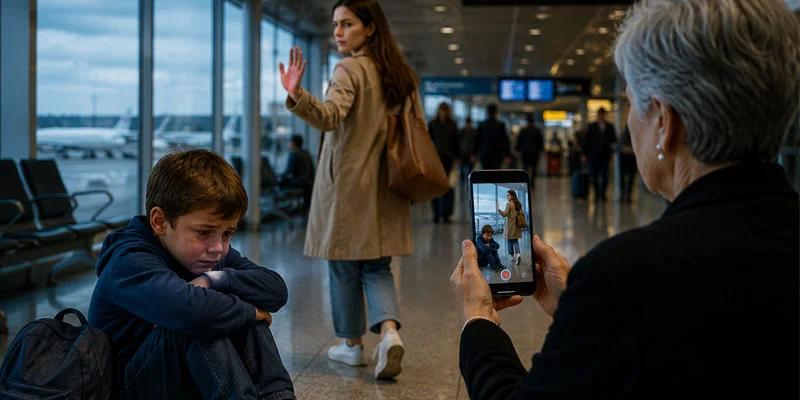
PART 3
I didn’t respond right away. I listened to the distant sound of waves and laughter behind him—hotel music, vacation noise, a world that hadn’t stopped for my grandson’s tears.
“You left a ten-year-old alone in an airport,” I said quietly.
“He wasn’t alone. Security was there.”
“He was abandoned,” I corrected.
A pause. Then his tone shifted, defensive.
“He was being punished. Lauren made a decision. We agreed—”
“No,” I interrupted. “You complied.”
That word landed heavy.
On the other end, I heard Lauren’s voice in the background, sharp and panicked: “What is she saying? Are they recording us?”
Daniel lowered his voice. “Mom, please don’t escalate this. We’re on vacation with the kids. We can sort this out when we get back.”
I looked through the hallway glass toward the guest room. Noah had finally fallen asleep, curled up like he was trying to make himself smaller than the world.
“You don’t understand something, Daniel,” I said.
“I understand plenty—”
“No,” I cut in, sharper now. “You understand convenience. You understand comfort. You understand keeping peace with whoever shouts the loudest in your house.”
Silence.
Then I added, colder than I intended:
“But you don’t understand consequences yet. You’re about to.”
I hung up before he could respond.
By morning, things were already moving.
I didn’t sleep much. I spent the early hours documenting everything again—screenshots, timelines, notes from the officer, and a written statement from Noah, gently dictated while he ate toast at my kitchen table.
He wrote slowly, spelling some words wrong, pausing often.
“He said I was bad… I was not allowed to go… I was left at gate…”
Each sentence felt like a weight on my chest.
At 9:15 a.m., I received a call from Child Protective Services.
The case had been opened.
At 9:42 a.m., Daniel called again—this time not angry, but unsettled.
“Mom,” he said, quieter, “they interviewed us at the hotel. Lauren is furious. They say we might have to cut the trip short.”
I closed my eyes for a moment.
“So you’re still there,” I said.
“Of course we’re still here,” he snapped, then softened. “Look, we didn’t abandon him. We were disciplining him. You’re making this sound—”
“I don’t need to make it sound like anything,” I said. “It already is what it is.”
He exhaled sharply. “We’re coming home early. Are you happy now?”
I almost laughed.
“Happiness has nothing to do with this.”
That afternoon, I took Noah to the park.
He sat on a swing without swinging, just moving slightly back and forth while watching other children play. At one point, a little boy about his age fell in the sand and immediately looked around for his mother.
His mother was already there, brushing him off, laughing softly.
Noah looked away.
“Grandma,” he said suddenly, “did I do something that makes people leave you?”
The question hit harder than anything else that day.
I knelt beside him.
“No,” I said firmly. “What happened to you says everything about them. Not you.”
He didn’t answer, but he leaned slightly toward me.
That was enough.
Two days later, their vacation ended early.
I knew before they landed because Lauren’s lawyer called first.
Then Daniel.
Then finally, Lauren herself.
Her voice was different now—no longer sharp, but controlled. Careful.
“This has gotten out of proportion,” she said. “We never intended harm. We thought discipline—”
“You left a child alone in an airport,” I said. “Stop dressing it up.”
Silence.
Then, quieter: “We want him to come home.”
I looked at Noah playing quietly on the living room floor with his toy cars.
For the first time since that morning at Gate B14, he looked calm.
“He is home,” I said.
And I ended the call.
That night, Noah asked me something unexpected.
“Are they in trouble now?”
I paused.