
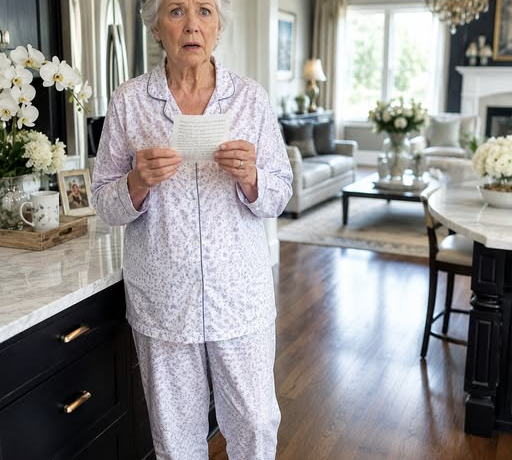
That was the note stuck to the refrigerator with a turkey-shaped magnet.
Margaret Collins read it three times, standing alone in the silent kitchen of her son Daniel’s house in Scottsdale, Arizona.
Thanksgiving morning had always smelled of cinnamon, fresh coffee, and butter. But that Thursday, the house smelled like nothing. There were no voices, no cartoons playing in the background, no sound of her grandchildren running down the hallway.
“Emily,” she called first.
Nothing.
“Jack.”
Silence.
She slowly went upstairs. The children’s beds were neatly made. Their backpacks were gone. Their jackets were gone too. In the master bedroom, Daniel’s and Rebecca’s suitcases were missing.
She came back downstairs with a strange calm—the kind that arrives before pain knows exactly where to settle.
The SUV was gone from the garage.
Rebecca’s car was gone too.
Only she was left.
And the note.
“We decided to spend Thanksgiving in Hawaii this year. We didn’t tell you sooner because we knew you would insist on coming. The flight is long, and you get tired too easily now. We’ll be back in a week. There’s soup in the freezer.”
Margaret placed the note on the table.
She was seventy-three, but she was not a child. She did not need anyone deciding whether she could board a plane, walk through an airport, or sit by the ocean.
What hurt most was not that they had gone without her.
It was that they had left her behind like a plant someone watered before leaving for vacation.
Four years earlier, after Arthur passed away, Daniel had told her,
“Mom, come live with us. I don’t want you alone. Besides, the kids would love having you close.”
Margaret sold her small apartment in Oak Park and moved to Arizona. She used part of the money for the down payment on the house. She bought the refrigerator, the living room set, the washer, the dryer, the curtains, the dining table, and even the Italian coffee maker Rebecca proudly showed off to her friends.
At first, they called her a blessing.
Little by little, that blessing became an obligation.
If Margaret wanted to go downtown with a friend, Rebecca would tighten her mouth.
“And who’s picking the kids up from swim practice?”
If Margaret said her back hurt, Daniel would sigh.
“Mom, we’re only asking you to help with dinner. It’s not a big deal.”
If she bought something for herself, Rebecca would comment,
“Well, good thing you can still afford little things, because expenses here are getting brutal.”
The sentence that finally broke something inside Margaret came six months earlier. Rebecca was on the patio, speaking on the phone, convinced no one could hear her.
“We can’t ask her to leave. She watches the kids, pays for things, and still buys groceries. It isn’t really her. It’s her money that’s saving us.”
Margaret had said nothing then.
She folded that pain into her chest like a needle hidden inside clothing.
But that morning, with the house empty and the note on the table, she finally understood everything.
They had not brought her to live with them out of love.
They had placed her there because she was useful.
Margaret poured herself coffee. She sat down. She looked at the dining table she had paid for, the curtains she had ordered, the blender she had bought after Rebecca said “a nice house shouldn’t have old appliances.”
Then she went upstairs to her room.
She opened the bottom drawer of her nightstand and pulled out a blue folder.
Inside were all the receipts.
Arthur used to tease her gently.
“Maggie, you keep receipts for bread.”
For the first time that day, Margaret smiled.
“Thank you, my love,” she whispered.
She took out a notebook and wrote on the first page:
Things that belong to me.
Then she began to make a list.
Refrigerator.
Living room set.
Dining table.
Washer.
Dryer.
Television.
Coffee maker.
Guest beds.
Curtains.
Lamps.
Dinnerware.
Patio furniture.
Each word gave her a little more air.
She searched for a moving company on her phone and called the first one that answered.
“Ma’am, it’s a holiday weekend, so we charge extra.”
“That’s fine,” Margaret said.
“When do you need the service?”
She looked at the note one more time.
“Tomorrow at eight.”
That night, she did not cry. She packed two suitcases, gathered her documents, wrapped Arthur’s photo in a towel, and placed the blue folder inside her handbag.
Before bed, she went back down to the kitchen. She took Rebecca’s note and placed it exactly where it had been.
Above it, in black pen, she wrote:
Thank you for showing me who was really family.
And then she knew that when Daniel came back from Hawaii, he would not return to the same house.
Or the same mother.
The movers arrived Friday morning right at eight.
Three men stepped out of a white truck in front of the house. The crew leader was named Frank. He wore a gray cap, carried a clipboard, and had the face of a man hoping not to get dragged into family problems.
“Good morning, Mrs. Margaret. What are we moving?”
“Everything on this list,” she answered.
Frank looked at the paper. Then he looked at the house.
“Are you sure?”
Margaret handed him the blue folder.
“The receipts are here. Everything is in my name.”
Frank checked several papers and nodded.
“Then we’ll get started.”
First went the ivory living room set. Then the coffee table, the lamps, the huge television Daniel used for football games, the eight-chair dining table, the refrigerator, the washer, the dryer, the coffee maker, the fine dishes, the entryway cabinet, and the linen curtains.
With every object that left, Margaret felt the house deflate, as if it had finally stopped pretending to be warm.
By noon, echoes bounced off the walls.
The kitchen looked like another place. No refrigerator, no blender, no coffee maker, no table. Only the cabinets and the note remained.
Margaret asked Frank to wait five minutes.
She went upstairs and checked her room one last time.
She did not take the children’s toys. She did not take their clothes. She did not touch anything that was not hers.
At the front entrance, she left the house keys inside a white envelope. She also left the electric, water, internet, and gas bills, each marked with the date she had canceled automatic payments from her account.
Beside Rebecca’s note, she placed another sheet of paper:
Daniel, starting today, your expenses belong to you again.
Then she walked out without looking back.
Her new apartment was in a retirement community in Santa Fe. It was small, bright, and quiet. It had a balcony, clean floors, a simple kitchen, and a blooming bougainvillea outside the window.
The manager handed her the keys.
“Welcome home, Mrs. Margaret.”
Home.
The word loosened something in her chest.
That afternoon, Frank and his team arranged her furniture. Arthur’s photo went on a shelf. The blue teapot he had given her sat beside the stove. The ivory sofa looked beautiful again, not because it was luxurious, but because it was no longer surrounded by contempt.
That evening, a neighbor named Helen knocked on her door with cornbread.
“I heard you arrived today. Around here, nobody eats dinner alone on their first day.”
Margaret tried to say she was fine, that it wasn’t necessary.
But Helen was already walking in with two plates.
For an hour, they talked about plants, old TV dramas, and aching knees. Margaret laughed for the first time in weeks.